
Managed Connectivity for Seniors: The Next Wave of Growth

The U.S. population continues to age rapidly, and the aging boom is reshaping the senior housing industry on several fronts at once. Baby Boomers now make up a growing share of the senior population and are living longer and healthier lives than the generations before them. The first members of the post-war cohort turned 80 in 2026, and the 80-plus population is on track to grow roughly 37 percent over the coming decade, compared with about 5 percent growth for the population overall, according to Pew Research Center and NIC MAP Vision projections.
Demand is showing up in the occupancy numbers. Senior housing occupancy averaged 89.9% in the second quarter of 2026, according to NIC MAP data analyzed by the National Investment Center for Seniors Housing & Care, marking the 20th consecutive quarter of occupancy growth, with occupancy at or above 90 percent in roughly half of the primary markets tracked. What is not showing up is the new supply. Year-over-year inventory growth was 0.4 percent, and fewer than 16,000 senior housing units were under construction nationally. NIC MAP Vision estimates the country needs approximately 806,000 additional units by 2030 simply to maintain current penetration rates.
That combination has a direct consequence for connectivity strategy: for the next several years, the senior living market is a brownfield market. Operators cannot build their way into a better resident experience, so they are expanding services inside buildings they already own. Connectivity is one of the few investments that improves resident satisfaction, staff productivity, and net operating income at the same time, and it can be deployed into existing stock without waiting on a construction cycle. The analysis that follows focuses on independent living, which is the largest segment of senior housing and the one where resident expectations, deployment economics, and platform capabilities line up most closely with conventional multifamily.
Connectivity Requirements Have Moved
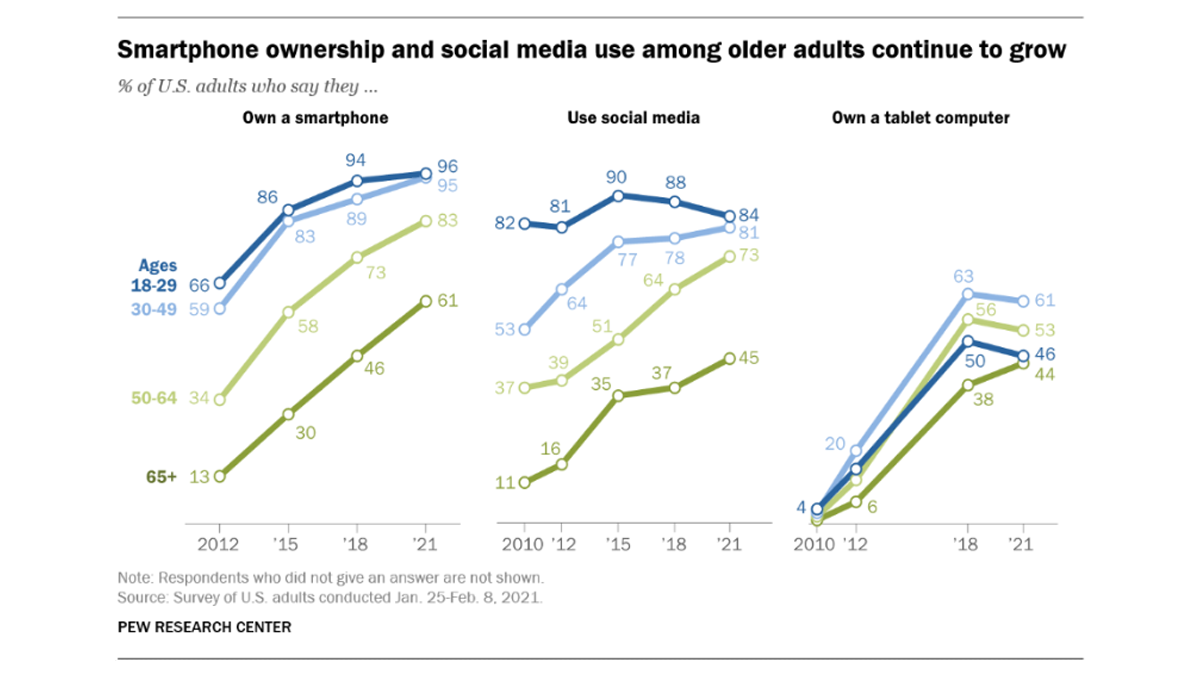
Contrary to a persistent stereotype, seniors are enthusiastic and increasingly capable internet users. According to Pew Research Center, smartphone ownership among adults 65 and older has reached 78 percent, while 70 percent have broadband internet at home. Linear and cable television still matter, but streaming has become the default for a large share of residents, and mobile applications for banking, video calling, gaming, shopping, and community engagement are routine.
As active residents move between their units and common areas, roaming becomes essential rather than a nice-to-have. Resident expectations in senior living now look much closer to conventional multifamily expectations than most operators assumed even three years ago.
Streaming Is the Baseline
Television remains the entertainment residents value most, but the delivery mechanism has shifted toward Netflix, Amazon Prime, YouTube, and similar services. Netflix recommends 5 Mbps or higher for full HD and 15 Mbps or higher for 4K ultra HD, while YouTube guidance commonly places 4K streaming at about 20 Mbps per device. In a community where a majority of units are streaming simultaneously in the evening, the design constraint is not headline speed but consistent per-unit performance under load.
Mobile Usage Keeps Climbing
Smartphones, tablets, and notebooks provide independence, autonomy, and social connection. Residents video chat with family, play games, read, stream, and order groceries, prescriptions, and takeout. Because the internet is property-wide, they can take a video call with a grandchild while walking the grounds. This is the practical reason property-wide coverage has become table stakes: the resident does not experience the network as a set of coverage zones, only as something that works or does not.
Community Applications
Isolation and loneliness increase with age, particularly once residents stop driving. Community applications carry announcements, calendars, activity sign-ups, group coordination, and push notifications, and they matter most for residents whose families do not live nearby. When on-site programming alone cannot fill the day, technology closes part of the gap. Every one of those applications assumes a network underneath it that residents can actually reach.
Roaming and Network Segmentation
Roaming matters because residents spend a great deal of time in dining halls, libraries, chapels, fitness rooms, and outdoor areas. It matters for staff as well, who process work orders on tablets, run virtual tours, and increasingly rely on connected operational tools.
This is where platform architecture starts to separate vendors. Calix SmartMDU, for example, provisions five distinct isolated virtual networks per property covering the in-unit experience, property-wide roaming, IoT, guest access, and connected or EV networks. That segmentation maps unusually well to senior living, where a single property has to keep resident traffic private, keep building IoT devices on a controlled network, give visiting family day-use access, and still deliver seamless roaming across common areas. As described in the Calix SmartMDU solution overview, the platform provides five distinct, isolated networks to align to a building’s needs.
Staff, Operations, and the Labor Constraint
Senior living carries a well-documented labor problem. Staffing shortages, rising costs, and low digitalization compound each other, and leaders are asked to do more with less every year. Connectivity is the layer that makes operational automation possible.
For community and administrative staff, managed Wi-Fi is foundational infrastructure. Staff working from tablets and phones can log work orders, coordinate maintenance, run tours, and update community systems from anywhere on the property rather than returning to a workstation. Digital signage, check-in kiosks, and wayfinding displays deliver real-time information to residents, visitors, and staff. Resident wearables and building devices sit on the dedicated IoT network, kept separate from resident and guest traffic, and visiting professionals who come on site for scheduled appointments have reliable coverage to reach their own systems without touching the resident network.
Emerging capabilities such as Wi-Fi sensing add a layer of intelligence on top of the same infrastructure, working alongside wearables and security devices on the property IoT network to support optional reassurance and check-in features for residents and their loved ones.
The operational burden of running that network is its own problem in a labor-constrained sector. Property staff generally do not want a network console; they want to add or remove a resident, see whether the building is healthy, and escalate when it is not. Platform vendors have converged on the same answer: give property management a purpose-built tool and give residents self-service. In the Calix implementation, PropertyWorx handles resident access management and network visibility for property teams, CommandIQ gives residents control over their own in-unit experience, and QR-code activation lets a resident turn up service at move-in without a truck roll. In senior living, where move-ins are frequent and on-site technical staff is stretched, eliminating routine truck rolls can have a meaningful operational impact, according to the SmartMDU on Calix One Drives Rapid Growth announcement.
Independent Living Is Leading Adoption
Independent living is where managed connectivity has the clearest and most immediate business case. Residents in this segment are active, socially connected, and digitally fluent. Many continue to work part-time, run small businesses, manage investments, work, or take courses online, and their bandwidth expectations are no different from those of any other apartment renter. They stream, video call, shop, bank, and bring their own devices with them when they move in.
That is why the deployment model looks so much like conventional multifamily. The requirement is a reliable in-unit experience, property-wide roaming across dining rooms, lounges, fitness spaces, and grounds, a clean self-service activation path at move-in, and a management tool that a small on-site team can actually operate. Communities that deliver it see returns in satisfaction and retention, which flow through to net operating income and property valuation. Where connectivity is treated as an amenity line item rather than infrastructure, prospective residents notice on the tour.
The Brownfield Problem
Most senior living inventory was built well before managed Wi-Fi was a design consideration. Construction has stalled at the lowest levels in more than a decade, which means the addressable opportunity sits almost entirely in retrofit. Older buildings bring the familiar constraints: concrete and plaster construction, limited in-unit cabling, awkward riser paths, and no tolerance for disruptive installs in occupied units.
Two things have made retrofitting meaningfully more practical over the past two years since we first published our report on senior living connectivity. Wi-Fi 7 systems in apartment-appropriate form factors, including ceiling-mount and compact in-unit units such as the Calix GigaPro 7p6 and GigaSpire 7u4, handle high-density environments with less reliance on new cabling. And platforms designed to support both greenfield and brownfield deployments remove the assumption that a property must be rewired end-to-end before managed services can be turned up. For operators who cannot take units offline, the deployment model matters as much as the radio specification, as outlined in the SmartMDU on Calix One Drives Rapid Growth announcement.
Persistent Challenges
Staffing shortages, inflationary pressure, elevated borrowing costs, and a constrained lending environment remain the dominant concerns for owners and operators. On the technology side, software incompatibility and organizational resistance to change continue to slow adoption. None of these are connectivity problems as such, but they get harder when the network cannot support integration.
Conclusion
Senior living communities have moved past the question of whether connectivity matters and into the harder question of how to deploy it into buildings that were never designed for it. With occupancy around 90 percent and construction at historic lows, the operators who differentiate over the next five years will be the ones who upgrade what they already own. Managed Wi-Fi, delivered on a platform built for multi-dwelling environments and supported by a service provider partner, is the most direct path available to them.
This article draws on Maravedis' research on senior living and multifamily connectivity, including Connectivity Trends for Senior Living in the United States, which includes interviews with leading service providers and property owners and market sizing for managed services and equipment. For current multifamily market sizing, see the Multifamily Rental Connectivity Market Analysis 2026 to 2031.

Related articles