The Real Value of AI? Rethinking What's Possible

If it's working, don't fix it. Most of us have said it. It sounds like discipline. It's actually neglect.
A lot of how we work started years ago, and we've been adding to it ever since without asking whether it still makes sense. As we piled on, the unwritten corporate playbook got thicker. Right now, leaving that playbook alone is expensive. Competition has never been tougher. Customers expect the same ease they get from other industries. Cost pressures keep building. The goals haven't changed: grow, run more efficiently, deliver better experiences, and most importantly, compete and win. What can't stay the same is how we get there.
That's where AI comes in. AI isn't the problem we're solving. It's one of the most powerful tools BSPs have to rewrite that playbook.
The best example I know is the Shopify story I shared on the ConneXions main stage.
Why AI adoption is more than automating tasks (it’s redesigning work)
Tobi Lütke, Shopify's CEO, runs the company on a blank-slate philosophy. Nothing keeps its place just because it's always been there. Every meeting, process, and habit has to earn its spot as if you were starting the company today. A CEO I worked for had his own name for it, beginner's mind. He used to ask, if you were building a company to compete against us, what would you do? Whatever that is, we should be doing it.
Shopify's COO put that philosophy to work. He went into the scheduling system and deleted every recurring meeting with three or more people. That freed up about 320,000 hours, the equivalent of adding 150 people. Think about what you could do with 150 more people. He knew some meetings would come back, but that wasn't the point. It was a forcing function. The easy thing would have been to let business continue on. Instead, teams had to ask whether each meeting mattered and whether they were working on the most important things.
Then Tobi applied the same philosophy to AI. His memo said no one could hire a new employee unless they could show leadership the work couldn't be done with an AI agent. The easy thing is to keep adding people. I did it at my last company. He wanted people to stop and ask whether there was a better way.
But he didn't stop at a mandate, because mandates don't really work. He put friction on the old way, then opened the tools up to everyone, along with training, resources, and experts. Engineering led the way, just like ours did at Calix. Then the other functions followed, because they knew where their own problems were and could solve them themselves.
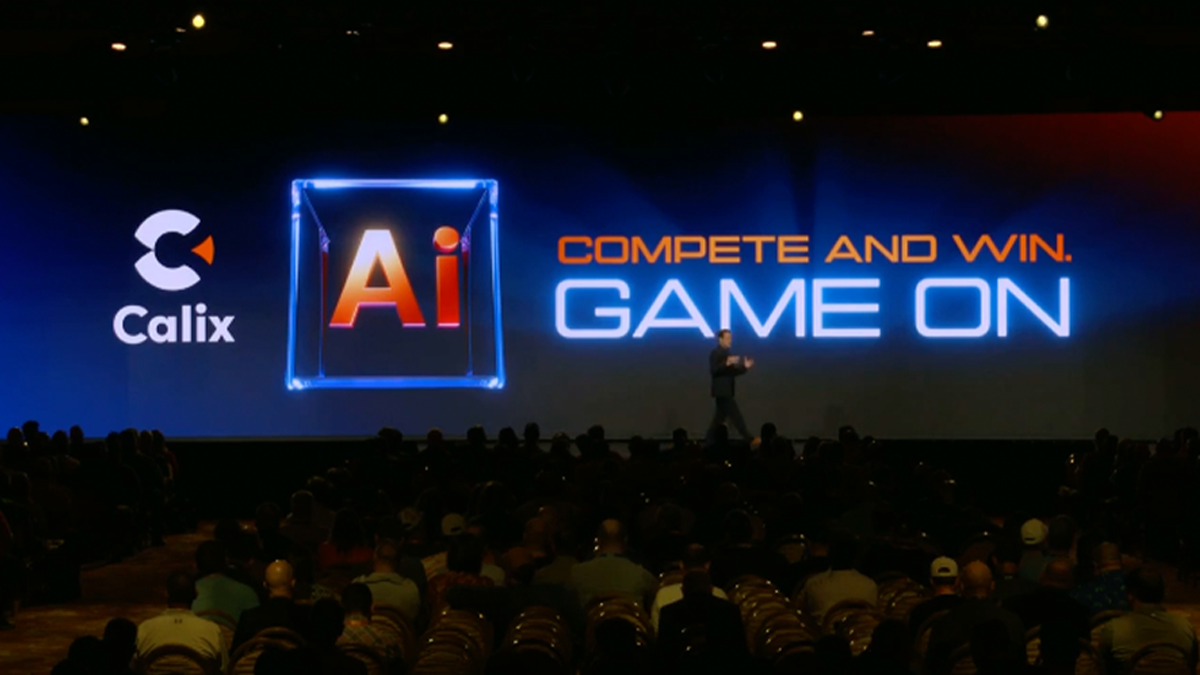
That's Tobi's philosophy at work, and it's the same theme that kept surfacing across the main stage and throughout ConneXions: the real opportunity isn't adding AI to the way we work today. It's rethinking the work itself. Instead of asking how AI can make what we already do a little faster, ask the blank-slate question: if we were starting today, would we even do it this way? Which steps disappear? Which handoffs go away? Where could people spend more time on the things only people can do? That's not automating a task. That's redesigning the work.
Why technology can never replace the people using it
And here's the part I find exciting. None of this makes people less important. Quite the opposite. Nancy Tichbon, our chief customer officer, called it the simplest equation she knows: AI + PI = ROI. PI is people intelligence. It's human judgment, empathy, experience, and the context only we can bring. AI can spot a subscriber who's thinking about leaving before they've made up their mind. But you know your communities inside out. As Nancy put it, AI without PI gives you products people don't buy, support people don't trust, and operations that go real fast but in the wrong direction.
Shopify shows what that looks like in practice. Tobi built an AI chief of staff that calls on other agents for finance, product, and operations so he can hear different points of view. But he was clear: AI can inform the decision; he still owns it. The same goes for the output. If you use AI, you're accountable for what you put out. We've all seen the presentation where somebody clearly asked AI to build it, and the same sentence shows up four or five times. That can't be the standard. The result was about 20% more productivity, time for projects and new products they hadn't been able to get to, and growth without adding people.
None of this is easy. Nobody wakes up on a Tuesday and says, you know what I think I'm going to do? I'm going to go look at our product and customer lifecycle and start over. We're doing this at Calix. It's hard work, and it has a cost. But by doing it now, you can break away.
You need AI people believe in, not just AI they “use”
And as AI becomes more important to how we operate our businesses, the bar goes up. People need confidence in it. They need to know they can rely on it, that their data is safe, that it will be there when they need it, and that it will deliver.
That confidence can disappear fast. One bad experience can be enough. Your subscribers are like that. Your teams are, too. The future isn't about deploying more AI. It's about building AI people believe in.
Technology creates the capability. Belief gives us the confidence to change. Purposeful action turns that belief into progress.
So, what's the leader's role in all of this? I don't think it's having all the answers about AI. I certainly don't, and I'd be skeptical of anyone who says they do. Our job is to create the conditions for people to challenge how things have always been done. Give them permission to question an old assumption. Give them the tools to try something different. Bring together what AI can do with what our people already know. Learn from it. And act on what we discover.
That brings me back to the framework I shared at ConneXions. First, challenge conventional wisdom. Question what you're doing today simply because you've always done it. Second, reimagine how you operate. And third, use technology to accelerate the change, pull away from the competition, and keep winning.
Because the objective was never AI adoption. It's to compete and win.
The real promise of AI isn't simply greater productivity. It's the ability to unleash ideas, capacity and possibilities that were previously out of reach. That's the opportunity in front of us: not just to make today's business better, but to imagine what comes next and have the courage to build it.

Related articles