Why AI Signals Go Ignored in Network Ops and What Has to Change

The network monitoring tool is live. The AI is flagging performance anomalies. The call analysis is summarizing every interaction. And the operations team is still running the same manual checks they ran before the deployment.
This is not a technology failure. The AI is working. The problem is that deploying AI into a network operations or customer service workflow is not the same as integrating it. When the management layer, the expectations, the protocols, the coaching, does not arrive alongside the technology, teams default to what they already trust. And that is not the AI.
Why the IT Project Frame Breaks Down in Operations
Traditional IT deployments are judged on stability, integration, and uptime. When the system is live and accessible, the project is done. AI deployments require something the IT project model does not account for: behavior change at the workflow level.
One CSP deployed AI call analysis across its customer service team. The technology performed as designed from day one. But frontline agents were not sure whether to trust AI-generated coaching feedback over their own instincts. Managers did not know how to act on automated call scores. The tool was live. Usage was minimal, because no one had defined what the tool actually required of the people running it.
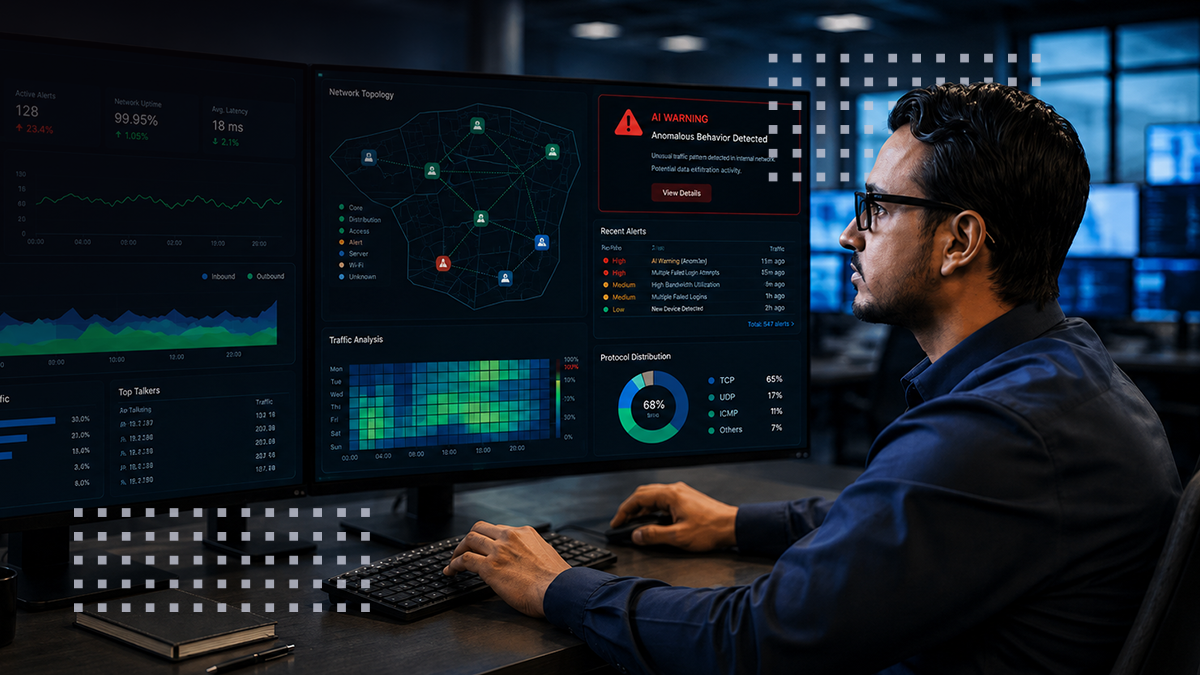
In network operations, the same pattern plays out differently but produces the same outcome. AI surfaces early indicators of degradation: elevated error rates, latency spikes, traffic anomalies. Engineers see the alerts. But if there is no protocol for how to triage AI-generated signals versus traditional alarms, the AI output gets treated as noise. Teams continue responding reactively to incidents that AI flagged hours earlier.
What AI Actually Changes in an Operations Workflow
AI does not just automate tasks. It changes the nature of the inputs that operations teams work from. That shift changes what expertise looks like in the role.
Network operations: The workflow shifts from responding to incidents after they surface to triaging AI signals before they become incidents. That requires engineers to develop judgment about AI output quality: which signals are reliable, which require validation, which can be acted on autonomously.
Customer service: Agents move from relying on their own notes and memory to working from AI-generated summaries and context. That requires trust in the accuracy of AI output and clarity about when to override it, neither of which develops without explicit guidance.
Field service: Technicians receive AI-informed dispatch prioritization and fault prediction. Acting on AI-generated priorities requires confidence that the underlying model reflects real-world conditions, which requires transparency about how the model works and what drives its outputs.
In each case, the bottleneck is not the technology. It is the absence of a clear framework for how the team is supposed to use AI output, and who defined that framework.
The Four Management Habits That Make AI Stick in Operations
There are four management habits that distinguish organizations where AI integrates into operations from those where it sits alongside operations without changing anything. Each is a leadership practice with direct consequences for how ops teams work day to day.
Detect emerging realities early: High-performing operations teams treat AI signals as actionable inputs, not background noise. This requires a triage protocol: which AI-generated alerts get acted on immediately, which get escalated, and which require validation before action. Without this, alert fatigue sets in and the signals that matter get lost in volume.
Manage the system as a whole: AI surfaces patterns across the full subscriber journey: network performance, care interactions, churn signals, field service trends. Operations leaders who use AI effectively look at how those inputs connect, rather than managing each metric in isolation.
Respond quickly to small signals: AI's operational value is highest when it catches issues early. Capturing that value requires a management rhythm that reviews AI-surfaced indicators on a cadence short enough to act on them while they are still small. Weekly reviews of lagging metrics do not support this. Daily or shift-level review of AI signals does.
Focus on creating new value: The most effective ops deployments use AI to enable work that was not previously possible: proactive subscriber outreach based on predicted churn, predictive maintenance before failure, coaching built from 100% of call interactions rather than a sample.
What Changes When AI Is Treated as a Capability
When leadership treats AI as an organizational capability rather than a technology deployment, the operations experience changes concretely. Engineers know which AI signals to act on and which to escalate. Customer service agents have clear override protocols. Managers review AI-informed performance indicators on a consistent cadence. New use cases get proposed and approved through a known path rather than sitting in a queue.
IT remains essential as the enabler that keeps AI running reliably. But operational ownership of how AI is used, when it is trusted, and how it integrates into workflows sits with the people running those workflows. That is the structural shift that turns AI from a parallel system into an integrated part of how the operations organization runs.

Related articles