
Brownfield vs. Greenfield, Old Coax vs. Fiber: A Service Provider’s Guide to MDU Deployment Realities
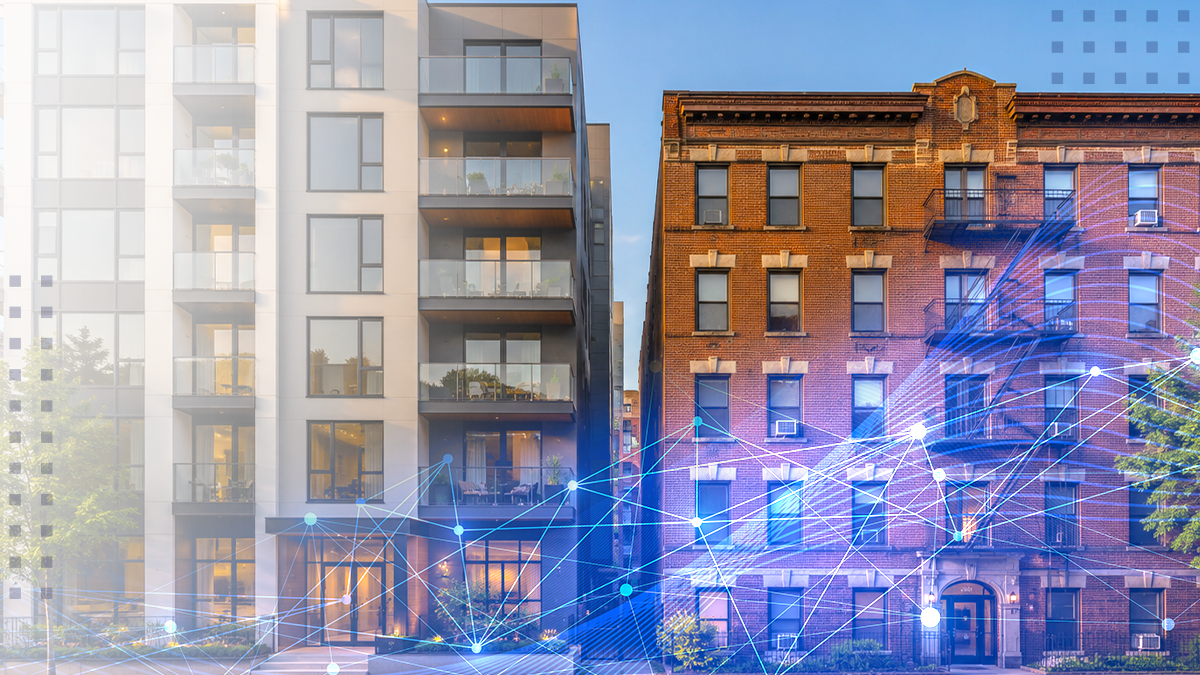
No two MDU properties are alike. A 100-unit high-rise built in 1998 presents a fundamentally different set of challenges than a 400-unit garden-style complex completed two years ago, or a new development that hasn’t broken ground yet. For service providers actively scoping deals, the physical environment isn’t just a technical variable. It drives every decision that follows: which technologies are viable, what the project will cost, and whether the deal that looks good on paper can be executed on the ground. Part of the value a service provider brings is knowing how to read that environment, and recommending the right approach for it.
Brownfield vs. Greenfield: Know Which Game You’re Playing
MDU deployments fall into two categories—brownfield and greenfield—and they present different challenges and opportunities. Depending on which you’re dealing with determines how to staff the deal, structure the contract, and set expectations with the owner.
Brownfield deployments mean retrofitting existing, occupied buildings, and they dominate the landscape. Nearly two-thirds of U.S. apartment stock was built before 2000, predating the structured cabling required by modern managed Wi-Fi. So, the central question is what’s already in the walls: coax, phone lines, Cat5e, or nothing usable. That infrastructure determines whether you can reuse what’s there or need to pull new cable, with real cost and timeline implications either way.
Greenfield deployments involve new construction or gut renovations—a clean sheet of paper. Earlier engagement is required, but the advantage is design control: getting involved before walls close means fiber to every unit or at minimum Cat6 can be specified, conduit roughed in, and telecom room placement locked down. When wireless access points are mounted during construction, with wiring hidden in the walls, the result is cleaner and cheaper than any retrofit. The infrastructure that results is more future-proof and often partially funded by the developer—though the sales cycle is long, with engagement to revenue spanning 12–18 months.
Brownfield vs. Greenfield: A Quick Comparison
| Brownfield | Greenfield | |
| Infrastructure | Work with what’s there or retrofit | Influence the design from the start |
| Timeline to revenue | 4–6 months | 12–18+ months |
| Cost complexity | Variable; depends on existing wiring | Often developer-funded during construction |
| Primary challenge | Adapting to aging or unknown infrastructure | Long pre-sales engagement; construction coordination |
| Key advantage | Large existing inventory of properties | Cleaner infrastructure, long-term asset value |
Brownfield Realities: What’s Hiding in the Walls
For brownfield properties, the infrastructure already in the building sets the parameters for everything else. The site survey is where that reality becomes clear, and where a service provider earns credibility by coming back with multiple options that let the owner weigh near-term budget against long-term goals.
Older buildings with coax and phone lines. Technologies like DOCSIS 3.1 and G.hn Wave 2 can push hundreds of megabits over existing coax. G.fast and VDSL2 can deliver decent speeds over phone lines on short runs. A useful middle path is fiber to the floor—bringing fiber to each floor’s telecom closet, then distributing over existing lines to units—which avoids the cost of running fiber all the way to each apartment.
Newer buildings with structured cabling. In buildings where Cat5e or Cat6 is already running to each unit, gigabit service is just a switch upgrade away. If fiber exists, active Ethernet or GPON can be layered on with minimal new wiring.
Insufficient or unknown wiring. Old Cat3, degraded coax, or no structured cabling at all calls for a decision: invest in new fiber or Ethernet runs or deploy property-wide managed Wi-Fi with a strong backhaul. In garden-style or low-rise buildings, managed Wi-Fi with access points in hallways or unit ceilings can be a practical and cost-effective path.
High-rise vs. garden-style. High-rises have vertical risers and centralized telecom rooms. Garden-style properties need fiber hubs feeding each building from a central point. Each layout requires a distribution plan built to match its physical reality.
No matter the scenario, the service providers that stand out are the ones who arrive with answers, not just questions—ready to walk an owner through exactly what a deployment would look like in their specific building.
The Case for Taking Fiber All the Way to the Unit
For new builds or major upgrades, fiber to the unit (FTTU) is the infrastructure standard worth pushing for. When fiber terminates at an optical network terminal (ONT) in each apartment, future speed upgrades become an electronics swap rather than a cable pull—and the property can credibly market itself as fiber-enabled, a designation that carries real weight with tech-savvy renters.
In occupied buildings, the trade-off is labor and coordination. Newer techniques—bend-insensitive fiber, microducts, adhesive cable—have made it more manageable, but it still requires careful planning. Frame the pitch to owners around asset value and competitive differentiation in lease-up. The long-term case is compelling; the short-term disruption is manageable.
Resident Expectations Don’t Change with the Building
Regardless of whether a property was built last year or 30 years ago, residents arrive with the same expectation: fast, stable internet—the same experience they’d have in a single-family home. In newer or luxury buildings, that bar may be even higher.
While fiber is the standard to aspire to, it’s not the right answer for every building today. That’s why matching the solution to the building matters as much as the technology itself. A well-executed deployment over legacy infrastructure—one that delivers consistent performance and responsive support—can meet resident expectations just as effectively as a fiber install. Resident satisfaction in MDU broadband tracks more closely with consistency and support quality than raw speed.
The Technical Conversation Is a Selling Opportunity
Technical complexity shapes every downstream decision: the proposal, the contract structure, and owner expectations. Getting it right requires more than technical knowledge; it requires knowing how to apply it to a specific building, with a specific owner, under real constraints.
The service providers that win aren’t always the biggest or the cheapest. Property owners have options; what they need is a service provider who can assess a building’s infrastructure and develop a plan that will serve the MDU now and well into the future. That expertise is what closes deals—and renews them.

Related articles